
When people from Mianzhu talk about their hometown, two things come up again and again: wine and New Year prints. One is fragrant in the cup, the other bright on the door, and both are bound up with the New Year and with the hope for good fortune.
One of China's four great print traditions
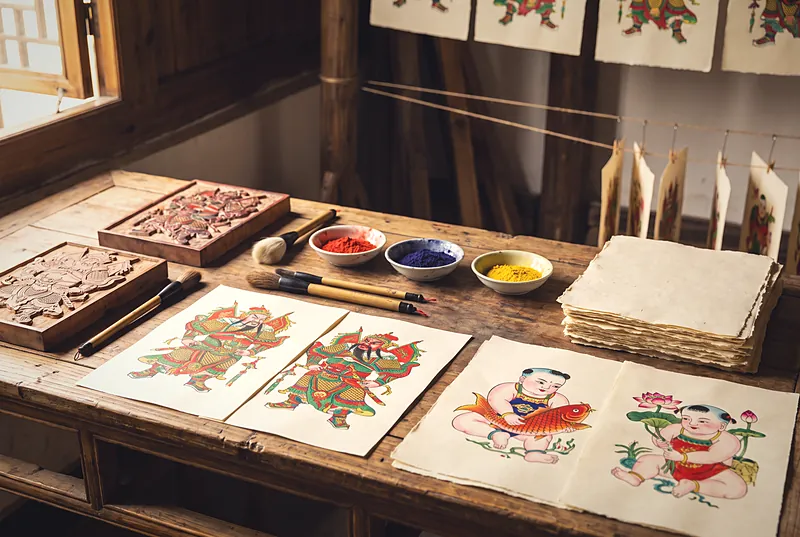
Mianzhu woodblock New Year prints are counted among China's four great nianhua traditions, alongside Yangliuqing in Tianjin, Taohuawu in Suzhou and Yangjiabu in Weifang, Shandong. In 2006 they were inscribed in the first group of China's national intangible cultural heritage 12. They are generally said to have begun in the Song dynasty and reached their height in the Qianlong and Jiaqing reigns of the Qing, when workshops crowded the town and prints were carried to Shaanxi, Gansu, Yunnan and Guizhou 2.
Wine and prints have long shared the calendar in Sichuan. A Song-era account of seasonal markets around Chengdu lists a "wine market" in the tenth month, followed by a "peach-wood charm market" in the twelfth. Those peach-wood charms, hung on doors to ward off harm, were one of the ancestors of door-god prints. New wine in autumn, new charms at year's end: the year's work closed with fresh fragrance and fresh colour.
Mianzhu prints come in two broad kinds: "red goods", hand-coloured in strong pigments, and "black goods", printed in ink with crisp, clean lines. Door gods are the most common subject, along with myths, opera stories and auspicious motifs.
Leftover colour and the Welcoming Spring scroll
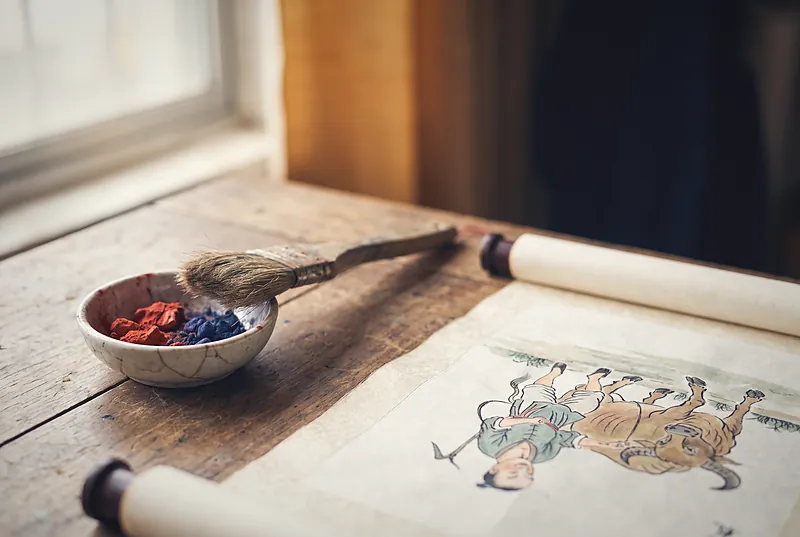
The most spirited Mianzhu prints may be the tian shuijiao, "filling in with leftover colour". The story goes that at the very end of the twelfth month, when the year's orders were finished, painters could not bear to throw away the paint left in their bowls. With a few quick strokes they filled in sheets and sold them at market for a little New Year money 1. Painted in haste and free of outlines, they have a loose, expressive quality, and today they are treasured.
Another landmark is Welcoming Spring (Yingchun Tu) by the late-Qing painter Huang Ruihu. Its four panels show the stages of the county town's spring rites, with more than 460 figures, officials, merchants, old and young, and it is often called "Mianzhu's Along the River During the Qingming Festival". It is now a nationally graded first-class cultural relic 3.
Blessings on the door, blessings in the cup
Underneath all of this lies one character: fu, blessing. Door gods guard the home; a child holding a fish wishes for "abundance year after year". Whatever the image, they all express an ordinary family's hopes for the coming year, and Mianzhu prints favour joy over hardship.
Qifu's name grows from the same soil: Qifu means "blessings, all together". The family distillery, at the foot of the Longmen Mountains and making spirit in Mianzhu since 1978, dresses its flagship in red with gold calligraphy, not far in spirit from a New Year print. At the New Year, a fresh pair of door gods on the gate and a bottle of Bainian Qifu · 8 on the table, or an everyday bottle of Jin Qifu, the family gathered and small cups poured slowly: that is how a wine town greets the year.
Prints fade and are replaced each year; bottles are finished and poured again the next. It is this yearly renewal that gives good fortune a shape you can touch.