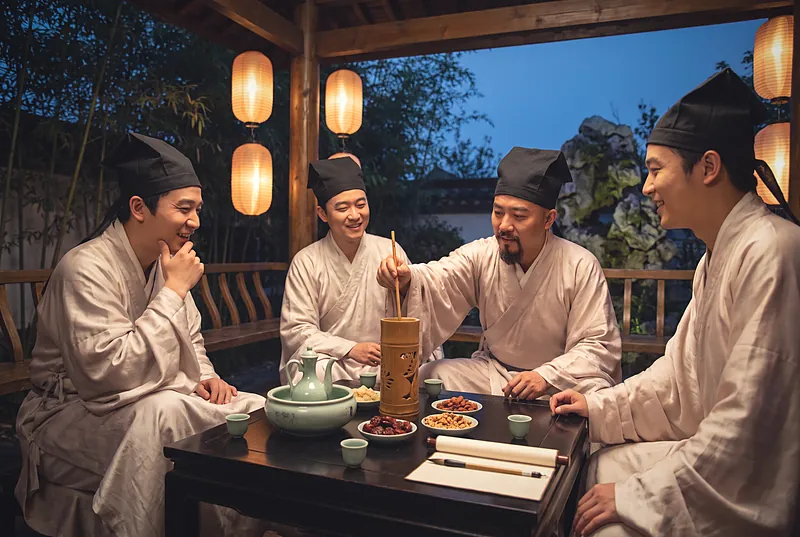
At a Chinese table, drinking has never been only about drinking. People of the past made rules for the fun of the feast, called jiuling, drinking orders: who drinks, and how much, was decided by a game. The beauty of the jiuling is that it turns a cup of wine into a contest of wit, skill and luck.
From pitch-pot to floating cups
Drinking games trace back to the ritual banquets of the pre-Qin era. The Book of Rites has a whole chapter on touhu, "pitch-pot": guests and host take turns throwing arrows into a pot, and the loser drinks. Archery was a formal ritual; pitch-pot brought it to the banquet table, keeping the courtesy while adding play.
In late spring of the ninth year of Yonghe (353 AD), the calligrapher Wang Xizhi gathered friends at the Orchid Pavilion near Shaoxing. Cups of wine were floated down a winding stream; whoever the cup stopped before had to drink and compose a poem. Wang's preface to the resulting poems, the Lantingji Xu, became the most celebrated work in the history of Chinese calligraphy. In it he wrote that a cup and a song were enough to express one's deepest feelings.
一觞一咏,亦足以畅叙幽情。
— Wang Xizhi, Preface to the Orchid Pavilion Poems
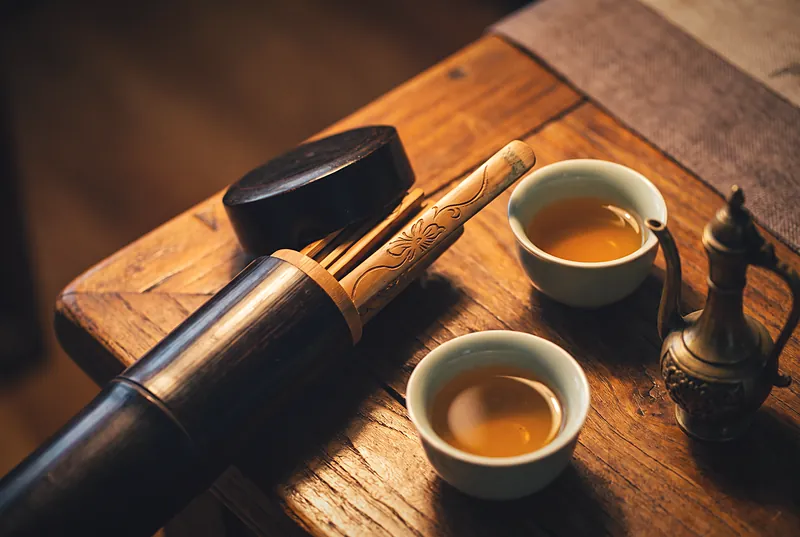
A Tang dynasty set of drinking lots
The Tang was the golden age of drinking games, often played with jiuchou, inscribed lots drawn from a holder. In 1982, a hoard of Tang silver was unearthed at Dingmao Bridge in Dantu, Zhenjiang, Jiangsu. Among the finds was a gilded silver holder in the form of a tortoise carrying a cylinder labelled Lunyu Yuzhu, holding fifty lots. Each lot pairs a line from Confucius's Analects with a drinking instruction: drink yourself, make another drink, or a set number of penalty cups 12. The piece is now in the Zhenjiang Museum and is graded a first-class national relic. Turning the words of the sage into a banquet game says a great deal about Tang humour and ease.
Flying flowers and flower lots
After the Song, word games multiplied. In feihua ling, "flying flowers", each guest in turn recites a line of poetry containing a given character, often hua, "flower"; whoever falters drinks. In Chapter 63 of Dream of the Red Chamber, the young women at a night party draw lots from a bamboo holder, each inscribed with a flower, a line of verse and a drinking rule, a vivid portrait of these elegant games. Among ordinary people, finger-guessing games were loud and lively, and they can still be heard at country banquets in Sichuan.
Drinking games were meant to lift the mood, not to make people drink more. When friends gather today, instead of pressing cup after cup on each other, try a game the old way: play "flying flowers", and let anyone who can't answer sing a song or tell a story instead. The forfeit doesn't have to be wine.
Qifu's Jin Qifu is the everyday bottle for exactly this kind of gathering, made at the family distillery at the foot of the Longmen Mountains in Mianzhu, a pure-grain, solid-state-fermented strong-aroma baijiu. A few old friends, home cooking, a bottle of Jin Qifu and small cups: whoever misses a line takes a small sip. Less drinking, more laughter. That is the real spirit of the drinking game.