
Vessels are the clothing of wine. Each kind of drink calls for its own container, and each age has its own way of drinking. Follow the vessels and several thousand years of drinking history take shape.
The Bronze Age: jue and ritual
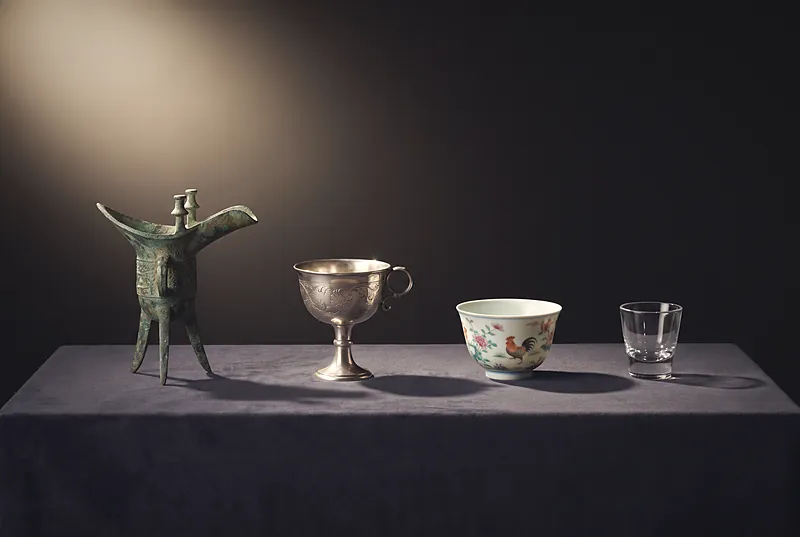
At Erlitou in Yanshi, Henan, a bronze jue decorated with raised nipple bosses was excavated in 1975. Standing about 26 cm tall, it is considered one of the earliest bronze wine vessels yet found in China and is displayed at the Erlitou site museum 1. The jue has three splayed legs, a long spout and small posts on the rim. By the Shang and Western Zhou, jue, gu, jia, zun and you formed full sets of ritual bronzes, each with its place in sacrifices and banquets 2.
The drink of that era was largely fermented grain wine, and the vessels were symbols of rank and ritual as much as tools for drinking. Their forms were solemn, their decoration fierce; drinking was close to sacred.
Lacquer, gold and silver: Han and Tang style
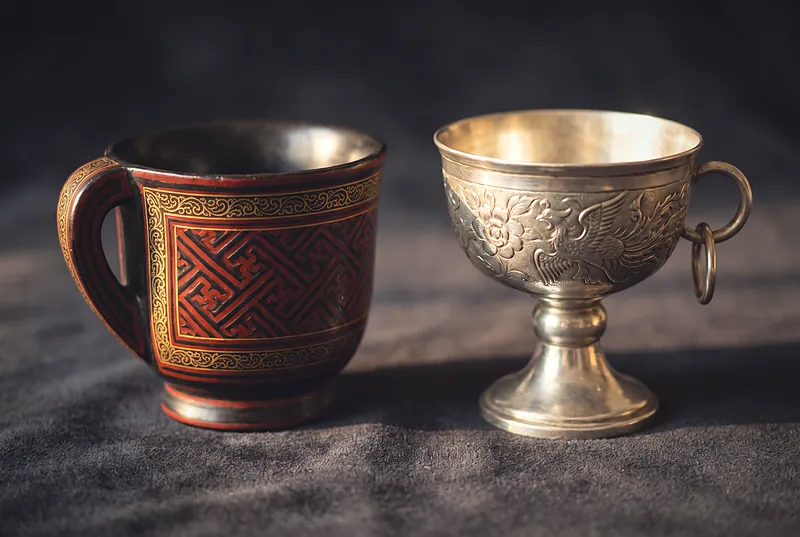
In the Han dynasty, lacquered "ear-cups" were popular: oval cups with a curved handle on each side, poetically called "feathered cups". The cups floated down the stream at the famous Orchid Pavilion gathering were of this light, graceful kind.
The Tang was powerful and outward-looking, and its vessels grew more splendid. The hoard unearthed at Hejiacun in the southern suburbs of Xi'an in 1970 contained a great many gold and silver objects, among them cups of varied shapes, some clearly showing Central Asian influence. The poet Wang Han caught the glamour of such cups in one line:
葡萄美酒夜光杯,欲饮琵琶马上催。
— Wang Han, "Song of Liangzhou"
("Fine grape wine in a cup that glows at night; as I raise it, the pipa on horseback urges me on.")
From Song porcelain to today's small cup
Song drinkers liked their wine warmed, often in a ewer set inside a bowl of hot water. Such sets can be seen in the painting The Night Revels of Han Xizai. Porcelain reached a peak in the Song, and celadon and bluish-white cups were smooth as jade.
In the Ming Chenghua reign, small cups painted in doucai enamels became famous for their delicacy, small enough to rest in the palm. Cups were getting smaller, perhaps not unrelated to the spread of distilled spirits: a stronger drink naturally calls for a small cup and slow sipping.
From the bronze jue of the ancestral temple to the porcelain cup of an ordinary home, wine vessels moved from ritual into daily life. Today, baijiu is still most often enjoyed from a small cup: porcelain, glass, or a tulip-shaped tasting glass. A small cup gathers aroma, and it slows you down.
Qifu's Bainian Qifu · 8, a 52% vol strong-aroma baijiu made from five grains, fermented in old yellow-mud pits in Mianzhu and rested in clay jars, is at its best in just such a cup. Pour it two-thirds full, note its clarity, breathe in the pit aroma, then sip, and feel the smooth entry and long, sweet finish. Three thousand years of vessels, and it all comes down to a small cup in your palm: a small vessel, a long story.