
Yellow: the clay that breathes
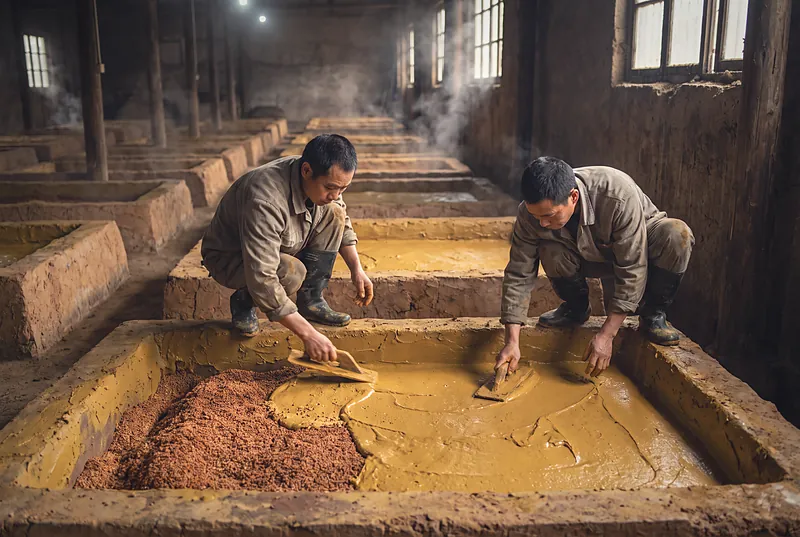
Walk into a strong-aroma distillery and the first thing you notice is not the spirit but rows of rectangular pits dug into the ground. Their walls and floors are made of yellow clay.
This is no ordinary mud. The yellow clay around Mianzhu is sticky and slightly acidic, and once it lines a pit it slowly becomes home to a huge population of microbes. The longer a pit is used, the richer that community becomes; old pits can host more than a thousand species. Some of these microbes produce caproic acid during fermentation, which goes on to form ethyl caproate, one of the signature aroma compounds of strong-aroma baijiu. The "pit aroma" at the heart of the style comes from here1.
Distillers like to say "thousand-year pits, ten-thousand-year grain". A pit is alive. As long as it is used continuously and cared for, the clay grows a little "older" every year, and so does the character of the spirit.
Red: the layer on top
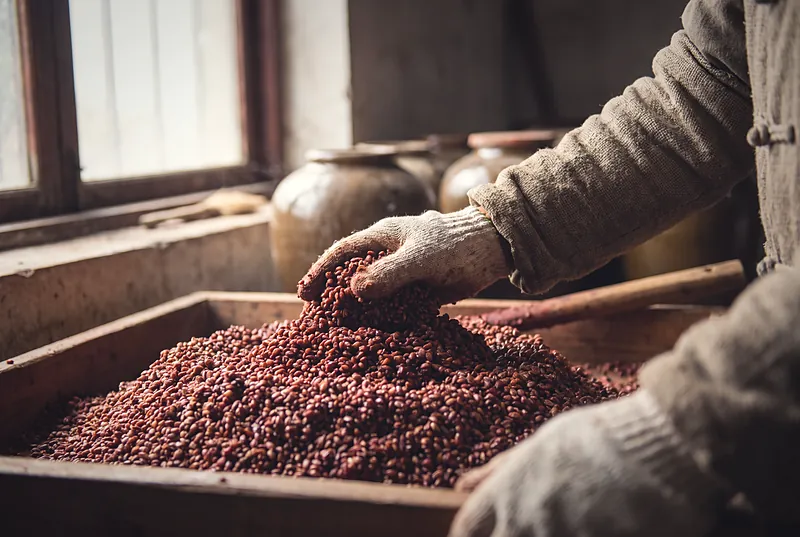
Another feature of strong-aroma baijiu is the continuous reuse of fermented grain. After each pit is distilled, most of the spent grain is mixed with fresh grain and qu starter and returned to the pit to ferment again. Round after round, the mash carries on from one generation to the next, which is what the "ten-thousand-year grain" refers to.
Within this cycle, one layer has a special role. After distillation it receives no fresh grain, only starter. Once cooled, it is spread across the very top of the grain in the pit like a cap. Distillers call it the "red grain", and the step is known as hongzao gaiding, "capping with red grain"1. It protects the grain beneath and steadies the fermentation. In the next round it becomes the top layer, is distilled once more, and then leaves the pit as spent grain, its job done.
Sealing the pit: between two colours
With the red grain in place, the final step is sealing. Workers cover the mouth of the pit with yellow clay, smoothing and patting it down to keep out the air. In the days that follow they check the surface often and patch any crack the moment it appears.
At Qifu we follow this same craft: pure grain, solid-state fermentation in yellow-mud pits, a red-grain cap, and about two months, roughly sixty days, sealed in the pit. When the pit is opened, the fermented grain goes into a traditional zeng still. The spirit is collected and graded by quality as it flows, then laid down in clay jars.
Whether it is our flagship Bainian Qifu · 8 or the more aged Qifu Laojiao 15 and 20, every bottle begins between this yellow and this red. Bainian Qifu · 8, five grains bottled at 52% vol, carries a full pit aroma; Laojiao 15 is clear, mellow and gently aged. The colours disappear, but the aroma stays in the cup.
Those sixty unseen days are days of microbes working quietly between yellow clay and red grain. Our part is to keep to the rules, never rushing and never cutting corners. Every cup of strong aroma comes from these two colours. Please enjoy it in small cups, and in moderation.