On the fifteenth night of the eighth lunar month, the moon is at its fullest. The Mid-Autumn Festival is a time for family reunion, and it is also the night poets have loved to write about most. For well over a thousand years, beneath that full moon, there has nearly always been a cup of wine.
Drinking alone with the moon, raising a cup to the sky
The Tang poet Li Bai loved the moon and loved wine. In "Drinking Alone Beneath the Moon" he sits among the flowers with no companion, so he invites the moon and his own shadow to drink with him:
举杯邀明月,对影成三人。
— Li Bai, "Drinking Alone Beneath the Moon"
("I raise my cup to invite the bright moon; with my shadow, we make three.") Loneliness becomes, in his hands, a party of three.
More than three centuries later, at Mid-Autumn in 1076, Su Shi was serving as prefect of Mizhou. His short preface says he "drank happily until dawn, became very drunk", and wrote the poem while thinking of his younger brother Su Zhe, whom he had not seen for years 2:
明月几时有?把酒问青天。
— Su Shi, "Prelude to Water Melody"
("When did the bright moon first appear? I raise my cup and ask the blue sky.")
The poem moves from that question to the reflection that people have sorrow and joy, parting and reunion, as the moon waxes and wanes, and that this has never been perfect since ancient times. It ends with a wish: may we live long, and though a thousand miles apart, share the beauty of the same moon. Longing becomes a blessing rather than a complaint, and this is probably the most widely loved line of any Mid-Autumn poem.
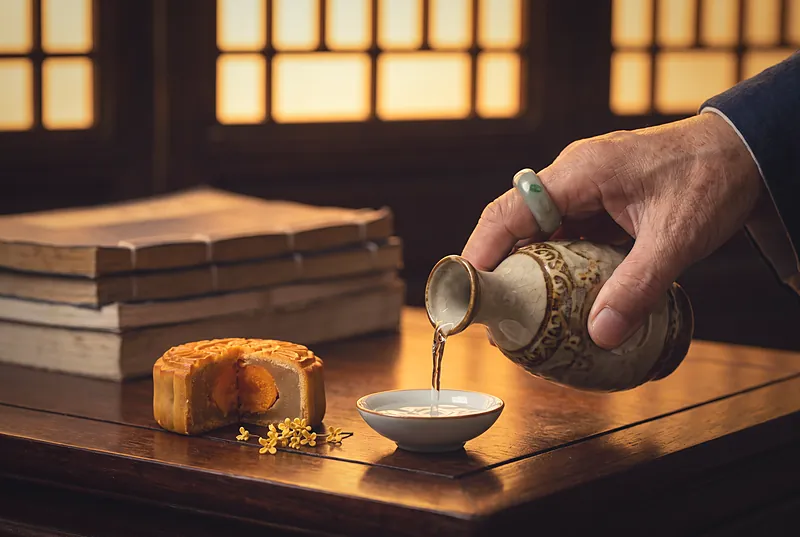
Wine and Mid-Autumn customs
Moon-viewing was already popular in the Tang and Song, and by the Ming and Qing, honouring the moon, eating mooncakes and gathering as a family had become fixed customs 1. In 2006 the festival was included in China's first national list of intangible cultural heritage, and since 2008 it has been a public holiday.
Wine plays an important part at the Mid-Autumn table. In many places people drink osmanthus wine; other families open a good bottle to toast their elders and those who have come home from far away. The family sits together, mooncakes are cut into shares, small cups are poured, and reunion needs no further words.
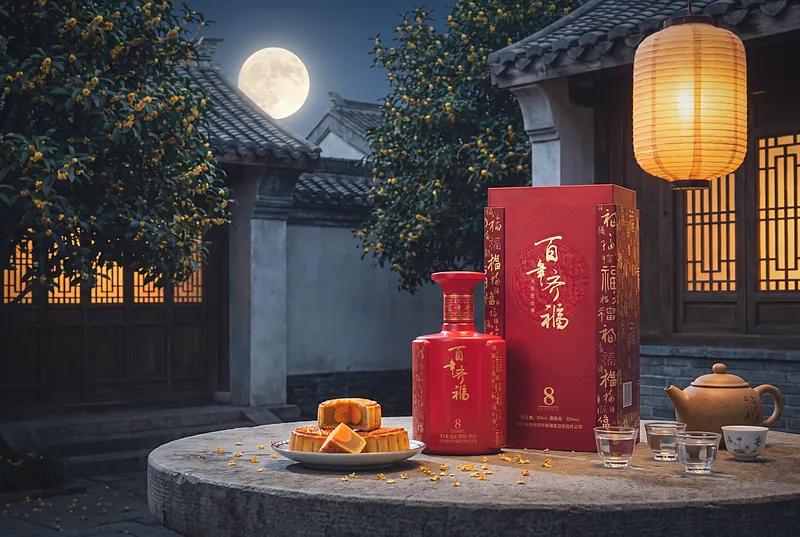
A bottle of Bainian Qifu · 8 for the family table
In Mianzhu, Mid-Autumn arrives with the scent of osmanthus. At the foot of the Longmen Mountains, the Qifu family distillery, run by the same family since 1978, makes pure-grain, solid-state-fermented strong-aroma baijiu.
For a Mid-Autumn dinner, Bainian Qifu · 8 is a fitting bottle: five grains, 52% vol, a smooth entry, lingering sweetness, full pit aroma and a nutty, caramel-like finish. Its red bottle and gift box with gold calligraphy are festive without being loud, and as a gift to elders and friends it carries the wish in its name, Qifu, "blessings, all together".
Moon-viewing nights are long, so keep the cups small and the sipping slow. When the moon reaches its height, pour a small cup for your family and keep a thought for those far away. A thousand miles apart, we still look at the same moon. That is the tenderness Su Shi wrote down more than nine hundred years ago.