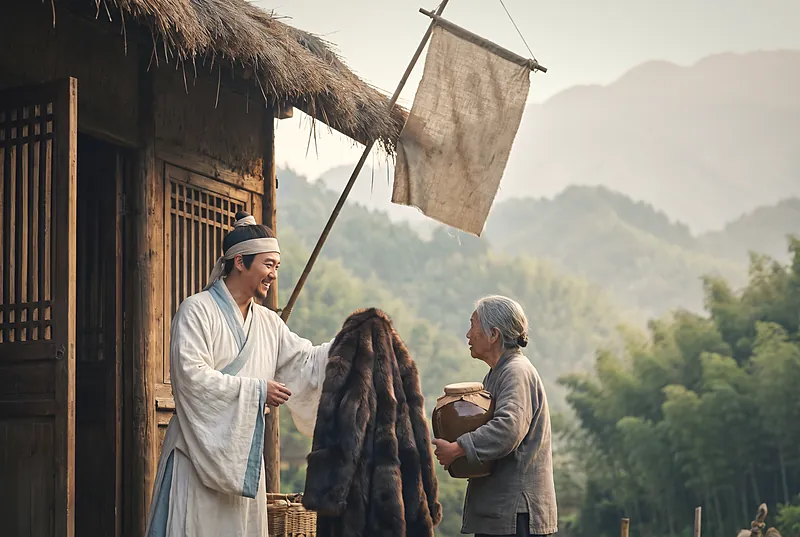
In Mianzhu people tell a story about Li Bai. The poet, travelling through, tasted the local wine and was in high spirits, but his purse was empty. So he took off his marten-fur coat and traded it for more wine. The tale is remembered as "untying the marten to redeem the wine" 2.
Between legend and history
This is a local legend, not something the official histories record, and it is best enjoyed as one. But legends seldom grow from nothing. Li Bai grew up in Changlong in Mianzhou, today's Jiangyou in Sichuan, not far from Mianzhu. He spent his youth wandering the Shu region and only in his mid-twenties, in his own words, "took up his sword, left his homeland and his family to travel far", heading down the Yangtze out of Sichuan 1. The landscapes and wine of Shu were the backdrop of his early years.
The image of trading furs for wine is also older than Li Bai. According to the Book of Jin, the Eastern Jin gentleman Ruan Fu once exchanged his gold-and-marten insignia for wine, and "marten for wine" became a byword for the carefree spirit of the literati. The Mianzhu legend lays that ideal over the figure of Li Bai, and ties it to the region's famous Tang wine, Jiannan Shaochun 3.
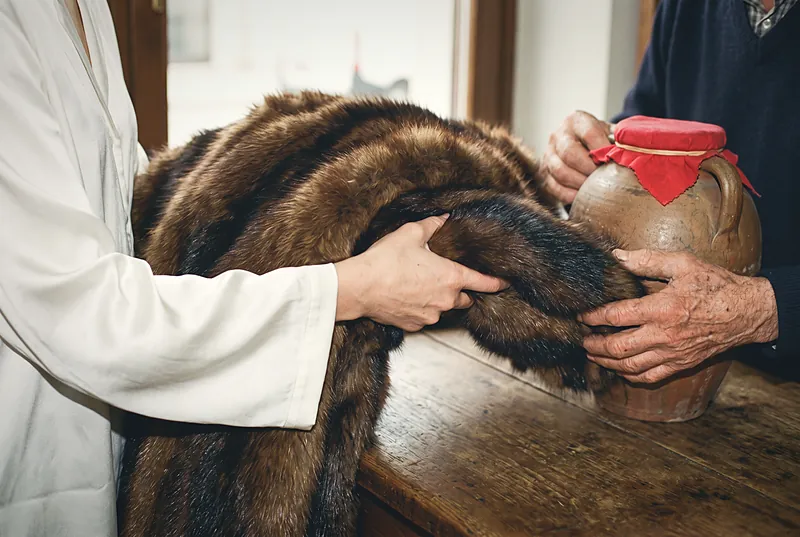
The thousand-gold furs of the poem
Whether the story is true may matter less than it seems, because Li Bai himself wrote almost exactly this:
My dappled horse, my thousand-gold furs: call the boy, take them out and trade them for fine wine.
— Li Bai, "Bring in the Wine"
For Li Bai, a fine horse and costly furs were worth less than an evening with a friend, "dissolving the sorrows of ten thousand ages" together 4. It is easy to see why Mianzhu people read this line alongside their own story. A poet, a fur coat and a jar of good wine: together they make the most memorable footnote a wine town could wish for.
Legend, poetry and a cup of Qifu
Half the charm of a wine country lies in its wine, and half in its stories. Mianzhu sits at the foot of the Longmen Mountains, with clear springs, plentiful rain and sticky, slightly acidic yellow clay. Han-dynasty brewing remains have been found here; in the Tang it was known for Jiannan Shaochun; the Southern Song Neo-Confucian scholar Zhang Shi was born here. These stories belong to the whole region, and they nourish every distiller working it today.
The Qifu distillery has been run here by one family since 1978 and keeps to the old strong-aroma methods: pure grain, solid-state fermentation in yellow-mud pits under a red-grain cap for about two months, distillation in a zeng still, cutting by quality and ageing in clay jars. To accompany an evening with poetry, Qifu Laojiao 15 Year may suit best: clean and sweet, with an elegant aged aroma, made for slow tasting. For a gathering of friends, the smooth entry and lingering sweetness of Bainian Qifu · 8 carry a little of that "trade it for fine wine" exuberance.
There is no need, of course, to give away your coat. Sip slowly from a small cup, keep a clear head for the poems, and you will have paid Li Bai the best tribute there is.