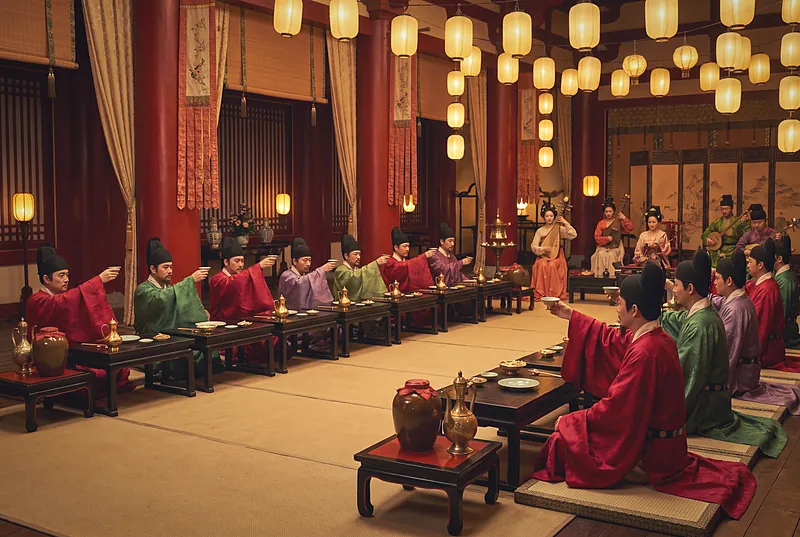
Talk about the spirits of Mianzhu and one name always comes up: Jiannan Shaochun. It belongs to the Tang dynasty and to the whole Mianzhu region, the shared pride of this stretch of land 1.
"The Shaochun of Jiannan" in the histories
The Tang writer Li Zhao, in his Supplement to the History of the Tang, listed the most celebrated wines of his day: the Fushui of Yingzhou, the Ruoxia of Wucheng, the Tukuchun of Xingyang, the Shidongchun of Fuping, and among them "the Shaochun of Jiannan" 3. Jiannan was the Tang circuit covering most of present-day Sichuan, and later tradition generally places Shaochun's home around today's Mianzhu.
A second, often-quoted record appears in the annals of Emperor Dezong in the Old Book of Tang. In 779, on taking the throne, Dezong set about cutting expenses and abolished a number of regional tributes. One entry reads:
The annual tribute of ten hu of spring wine from Jiannan: abolished.
— Old Book of Tang, Annals of Dezong
So before that year, Jiannan's spring wine had been sent to the court as tribute year after year 4. That a local wine should appear in an official dynastic history says a great deal about its standing.
As for the name, Tang writers often used chun, "spring", to mean wine. The shao, "burnt" or "heated", has prompted much discussion; some link it to heating or distilling the wine. Scholars have not settled the question, and it is best left open.
A wine country since the Han
Mianzhu's brewing history reaches back further still. Han-dynasty pottery and other remains connected with brewing and feasting have been found locally, showing that wine-making and banqueting were well established here two thousand years ago 2. Glacier-fed springs from the Longmen Mountains, a humid climate with more than 1,200 mm of rain a year, and sticky, slightly acidic yellow clay make an ideal home for brewing microbes. In 2019 the China Alcoholic Drinks Association named Mianzhu a "World Fine Spirits Characteristic Region", recognition of what this land offers.
A region's heritage, a family's craft
Jiannan Shaochun is the glory of the region, not the property of any single company. Every distiller who works this land carries the tradition forward in its own way. The Qifu distillery is one of them. Run by one family since 1978 and formally registered in 2001, it still makes strong-aroma baijiu by traditional methods: pure grain, solid-state fermentation in yellow-mud pits under a red-grain cap for about sixty days, distillation in a zeng still, cutting by quality, and ageing in clay jars.
Bainian Qifu · 8 is Qifu's flagship: five grains, 52% vol, a smooth entry, lingering sweetness, full pit aroma and a nutty, caramel-like finish. It is not a Tang tribute wine, but it comes from the same mountains and water and draws on the brewing tradition this region has handed down for generations. There is no need to claim a thousand years for it. It is enough to remember that good spirit has always depended on good land and on people patient enough to wait.
History is best read slowly, and so is spirit best drunk. Sip from a small cup, and the depth of a whole region comes through.