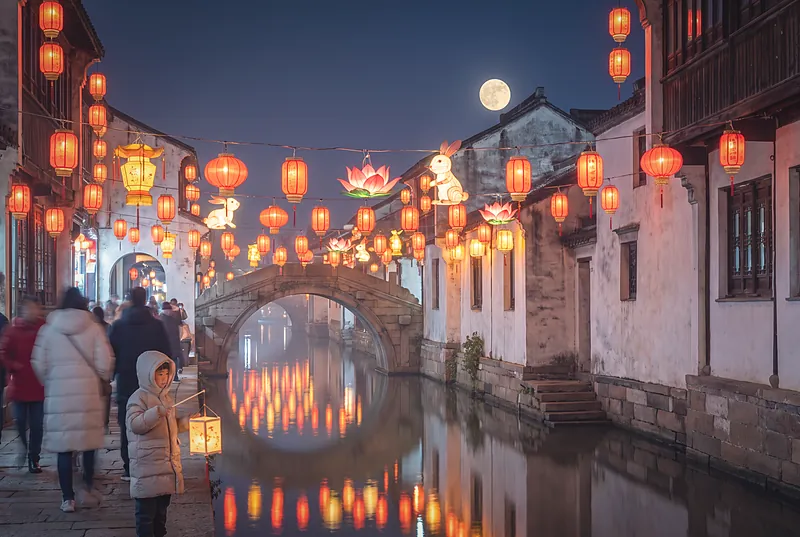
The fifteenth day of the first lunar month brings the first full moon of the year. The ancients called it Shangyuan; today it is the Lantern Festival, or Yuanxiao 1. The New Year ends on this day, and the lanterns burn brightest on this night.
The night the curfew was lifted
Hanging lanterns for the festival was already a flourishing custom by the Sui and Tang dynasties. The Tang capital normally kept a strict night curfew, with ward gates shut after dark. Only around Shangyuan did the authorities relax it, letting people stroll and watch the lanterns all night long. The Tang poet Su Weidao captured the scene:
Fire trees and silver flowers join; the star bridge's iron locks are opened.
— Su Weidao, "The Night of the Fifteenth"
"Fire trees and silver flowers" has meant lantern-night splendour ever since 2. In the Song dynasty the festival grew grander still. Accounts such as Dongjing Meng Hua Lu and Wulin Jiushi describe towering lantern hills in Kaifeng and lantern markets in Hangzhou. Xin Qiji's lyric on the festival opens with an east wind that "sets a thousand trees in bloom" at night, and ends with a figure glimpsed, on turning round, where the lantern light grows dim, one of the most famous images in Chinese verse 3.
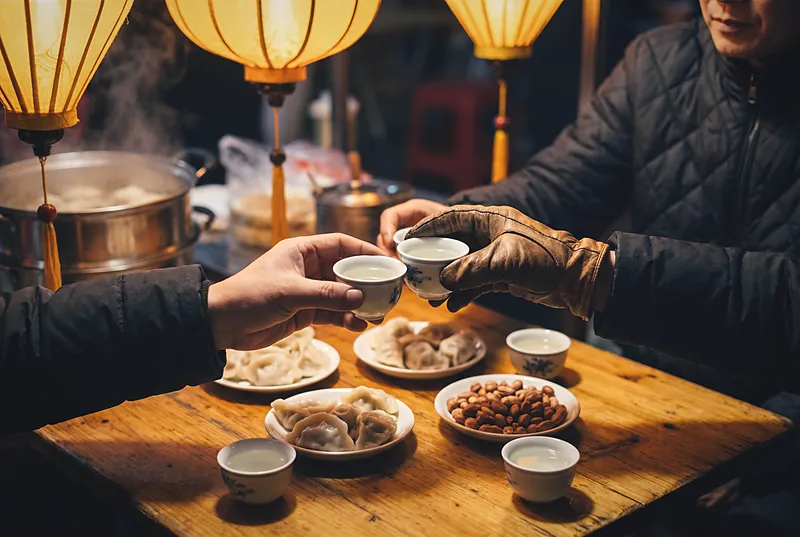
Eating and drinking at Shangyuan
The Lantern Festival is also a festival of food. In the Song, sweet rice-flour balls cooked in water were called "floating rounds"; later the north called them yuanxiao and the south tangyuan. A bowl of them, sweet and soft, stands for the family made whole. Lantern riddles were already popular in the Song: riddles written on slips of paper and pasted to lanterns for passers-by to guess, a game still played today.
Drinking under the lanterns was an old custom too. After the lantern fair, the family would gather for a late supper with wine; scholars would meet to compose linked verses beneath the moon. The Shangyuan cup is less solemn than the one on New Year's Eve. The year's great rituals are done, and it is a time to talk slowly with family and friends.
A cup of Qifu at the Lantern Festival dinner
Only after the Lantern Festival is the New Year truly over, and many people leave around this time to go back to work or school. So the Lantern Festival dinner often carries a note of farewell. It need not be as lavish as the reunion dinner. A few home-style dishes, a pot of tangyuan and a good bottle are enough.
If a bottle of Bainian Qifu · 8 is still waiting from before the New Year, this is the moment to open it. Made from five grains in the strong-aroma style at 52% vol, it enters smoothly with a long sweet return and a nutty, caramel-like finish that sits well with Sichuan home cooking. For a simpler gathering, an everyday bottle from the Jin Qifu range is just as fitting. Both come from the Qifu distillery at the foot of the Longmen Mountains in Mianzhu, where one family has kept its yellow-mud pits since 1978, making pure-grain spirit by solid-state fermentation under a red-grain cap and resting it in clay jars. The name Qifu means "blessings, all together", well suited to the last family gathering of the season.
The lantern fair is lively; the family table is warm. Come home from the lanterns, share small cups slowly, talk about the year ahead and wish the travellers a safe journey. That, perhaps, is what the ancients meant by Shangyuan.