

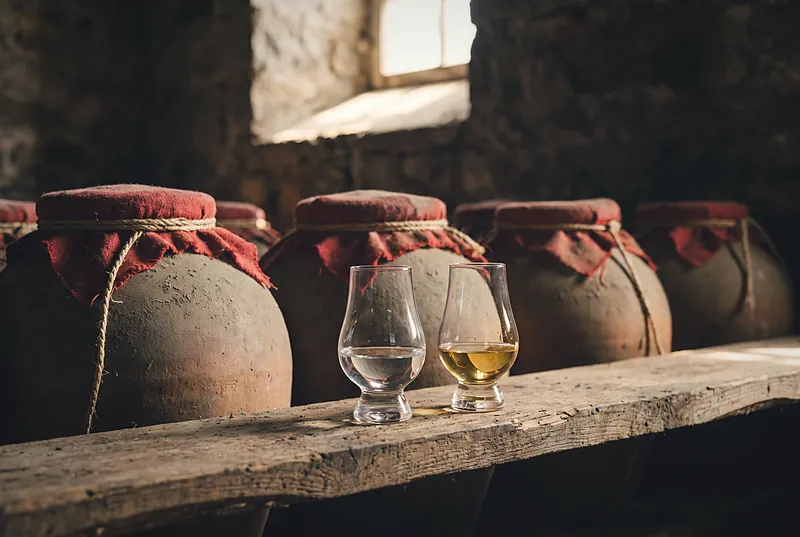
Freshly distilled baijiu is what distillers call "new spirit". It is clear and bright, with an assertive aroma, but on the palate it often has a hot, rough edge. Put it in a clay jar and leave it for a year, several years or longer, and when you open it again it usually seems softer and its aroma deeper. What exactly has time done?
New spirit contains small amounts of low-boiling, sharp-smelling compounds, including certain aldehydes and sulphur compounds. They are present only in traces, yet enough to make a spirit smell pungent and taste harsh 1. During storage these volatile components slowly escape, and the "new spirit" character fades.
Chemistry in slow motion
Ageing is not simply leaving the spirit alone. Researchers group the changes during baijiu maturation into a few broad kinds: evaporation, oxidation, esterification and hydrolysis, and molecular association 23.
With tiny amounts of oxygen, alcohols slowly oxidise into aldehydes and acids. Acids and alcohols in turn combine, very gradually, into esters that bring new aromas, while some existing esters break down again. Even ethyl hexanoate, the backbone of strong-aroma baijiu, shifts in concentration over long storage. So an aged spirit is not simply "stronger-smelling"; it is more integrated and more refined, and the "aged aroma" people talk about comes from these layered changes. Ethanol and water molecules also slowly rearrange and associate, which is thought to be one reason aged spirit feels softer in the mouth.
Why clay jars?
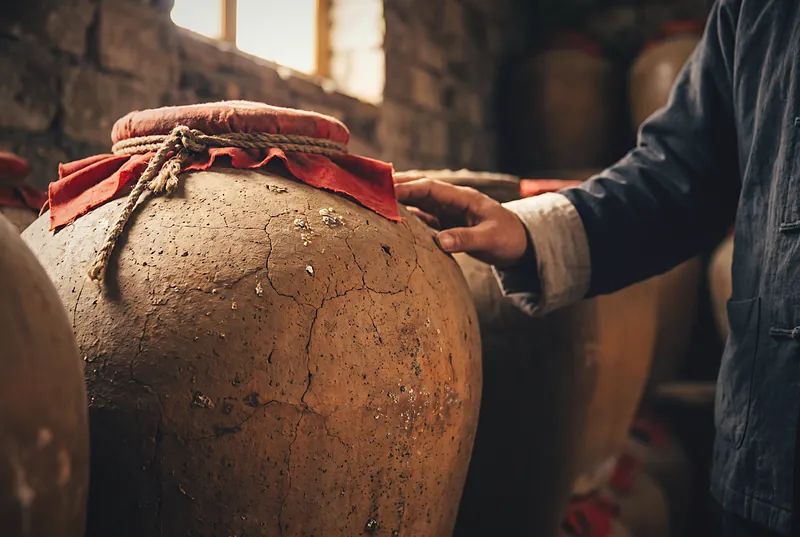
Traditional distilleries prefer to age baijiu in clay jars. The jar walls are finely porous, letting minute amounts of air pass in and out and creating conditions for oxidation and esterification. Trace metal ions from the clay dissolve into the spirit and are thought to help these reactions along 2. Compared with a sealed steel tank, spirit in a clay jar matures as if it can breathe.
Time is not automatically better, though. Storage temperature, the vessel and the quality of the original spirit all shape the result. Good base spirit plus suitable ageing makes good aged spirit, and the blender's experience matters greatly in balancing spirits of different years and batches.
Old pit, old spirit
It is worth noting that "old pit" and "old spirit" are two different things. The first refers to the age of the fermentation pit: the older the pit mud, the richer its microbes and the fuller the pit aroma. The second refers to how long the spirit has rested in the jar. The finest spirits often have both.
The Qifu distillery, below the Longmen Mountains in Mianzhu, has made strong-aroma baijiu in yellow-clay pits since 1978 and ages its spirit in clay jars; its oldest reserves are as old as the distillery itself. Qifu Laojiao 15 and 20 express that accumulation of time. The 15 is described as clear and sweet, firm yet gentle, with an elegant aged aroma and a soft, rounded body. "Firm yet gentle" neatly captures the meeting of new spirit's edge and old spirit's softness.
Aged spirit is best enjoyed in a small glass, slowly: nose it first, then sip and let time unfold again on the palate.