
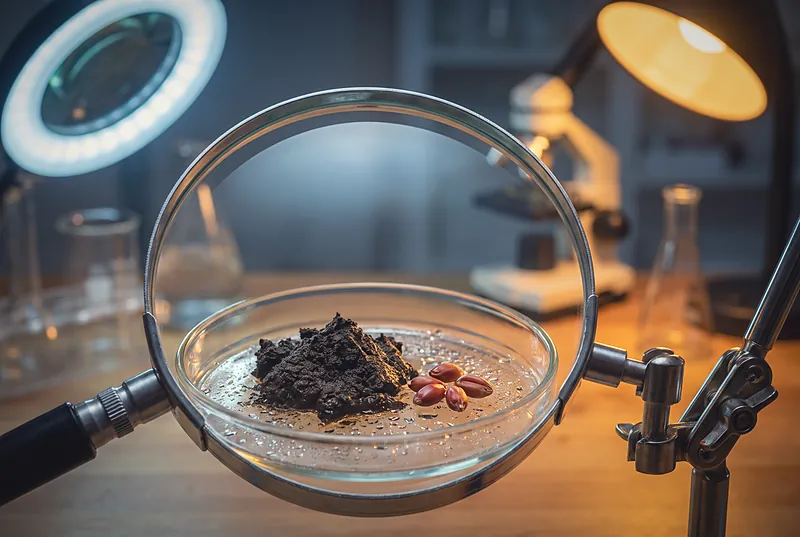
In a glass of clear baijiu you cannot see a single living thing. Yet if you wind back the clock, almost every note in that glass comes from a world invisible to the naked eye: the world of microbes.
Qu: where fermentation begins
Baijiu starts with qu, the fermentation starter. Strong-aroma baijiu mostly uses daqu, bricks made chiefly from wheat. As the bricks incubate in the qu room, they gather moulds, yeasts and bacteria from the grain, the air and their surroundings 1. Moulds break the starch in grain down into sugars; yeasts turn those sugars into alcohol; bacteria contribute organic acids and the building blocks of aroma. A good qu brick is a complex microbial community in its own right.
Pit mud: the secret of strong aroma
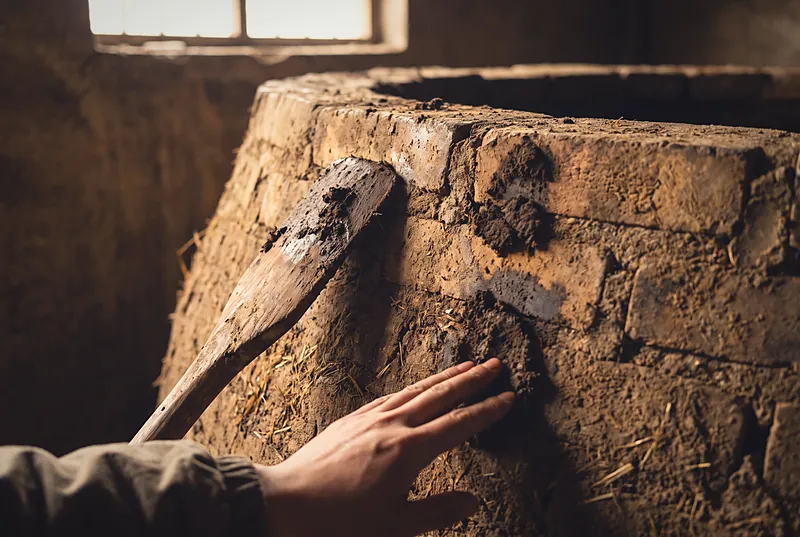
What sets strong-aroma baijiu apart is the mud pit. The walls and floor of each fermentation pit are lined with yellow clay, and with years of use the mud becomes home to vast numbers of anaerobic microbes. Bacteria of the Clostridium group and methane-producing archaea are particularly important 2.
They share the work with surprising elegance. Some bacteria convert ethanol, lactic acid and similar compounds into butyric and caproic (hexanoic) acid. Methanogenic archaea consume the hydrogen released during fermentation, which helps those acid-forming reactions proceed. Caproic acid then combines with ethanol to form ethyl hexanoate, the backbone aroma of strong-aroma baijiu, with its pineapple-like fruitiness 23.
Research has also shown that as a pit is used year after year, the microbial community in its mud gradually shifts and settles into a more mature, stable structure 2. Hence the distillers' saying, "a thousand-year pit, ten-thousand-year grains". An old pit is precious precisely because it nurtures generation after generation of microbes. Old pit mud in the Mianzhu area hosts more than a thousand microbial species; they are the region's true master craftsmen.
Interestingly, the microbes themselves do not end up in the glass. Distillation in the zeng still leaves them behind, and what remains are the aroma compounds they created during roughly two months of fermentation. A glass of baijiu is a portfolio of the microbial world's work, rather than the microbes themselves.
Qifu's yellow-clay pits
The Qifu distillery lies below the Longmen Mountains in Mianzhu, where rain is plentiful and the local yellow clay is slightly acidic and very sticky, ideal for building and nurturing pits. Since 1978 the family has made strong-aroma baijiu in yellow-clay pits: grain goes in, is sealed under a cap of red fermented grains to keep air out and the pit anaerobic, and after about sixty days the pit is opened and the grain distilled in a traditional zeng still, with the spirit selected by quality as it runs.
What the distillers can do is look after these invisible partners: keep the pit mud moist, tend the pits on schedule, and keep them supplied with grain. The full pit aroma of Bainian Qifu · 8 and the mellow, aged depth of the Qifu Laojiao series are work shared between these microbes and the people who care for them.
Next time you raise a glass, sip slowly and spare a thought for the bustling microscopic world behind it.