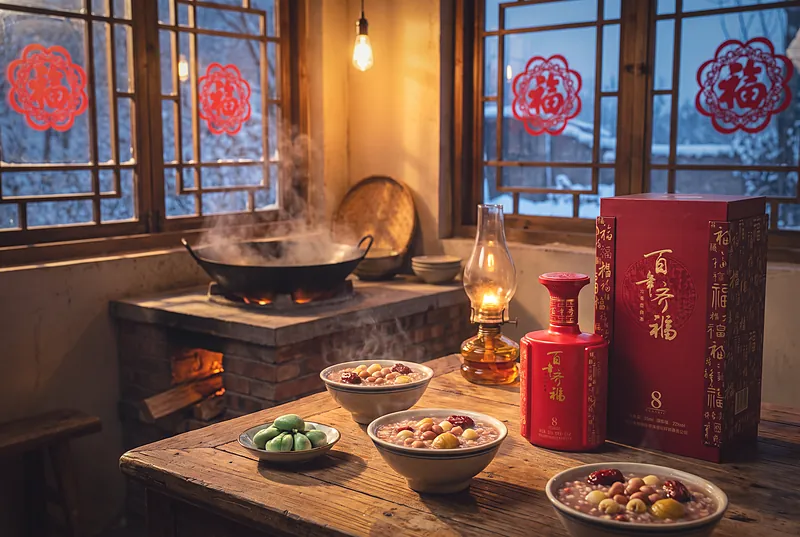
The eighth day of the twelfth lunar month is Laba. An old saying goes, "once Laba has passed, the New Year is here." From this day on, households begin the long run-up to the Spring Festival: sweeping out the dust, buying provisions, writing couplets. In the Sichuan countryside a pot of Laba congee simmers on the stove, fresh red paper-cuts glow on the windows, and the year turns slowly toward its end.
From year-end rites to Laba congee
La was originally the name of a year-end sacrifice. When the farming year was done, people offered game and harvest to their ancestors and the gods in thanks, and the twelfth month came to be called layue, the month of the La rite 1. The sixth-century Jingchu Suishiji, a record of seasonal customs, already names the eighth day of the twelfth month as the La day, when villagers beat drums to drive out sickness and welcome spring. After Buddhism arrived, the date also became linked with the Buddha's enlightenment, and monasteries cooked congee as an offering and gave it to the people. By the Song dynasty, Meng Yuanlao's Dongjing Meng Hua Lu records that the great temples of Kaifeng presented their followers with a "seven-treasure, five-flavour congee" on this day, "called Laba congee" 2.
Rice, beans, dates, chestnuts, lotus seeds: every region has its own recipe, but the meaning is shared. Many grains in one bowl, for a year of plenty to come.
Winter wine for the new year
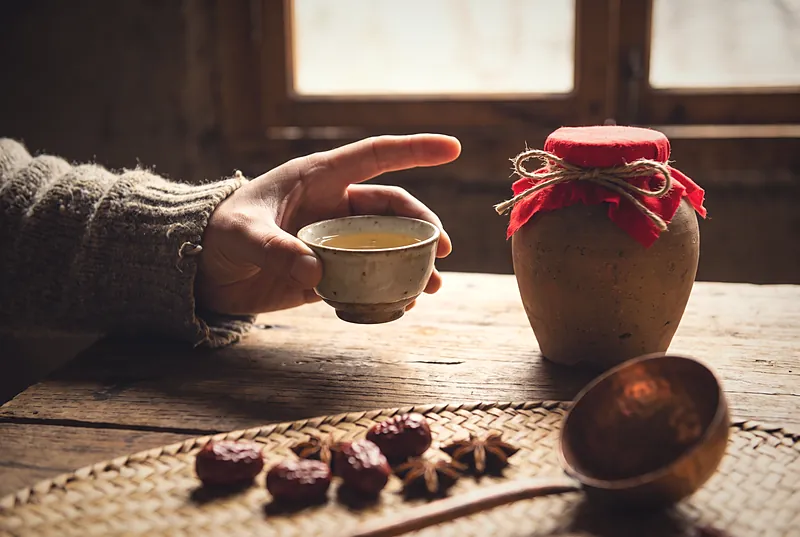
The twelfth month was not only for congee. It was also a time to brew and seal jars. In the cold, fermentation runs slowly, and in many places families brewed in this month and kept the wine for New Year guests. They called it lajiu, wine of the La month. The Song poet Lu You, writing in his home village, put it simply:
Don't laugh at the farmer's cloudy winter wine; in a good year there is chicken and pork enough for guests.
— Lu You, "Visiting the Village West of the Mountain"
Cloudy wine did not matter. What mattered was the hospitality of a good harvest year 3. In many homes the "New Year wine" is still planned from the twelfth month: which jar is for New Year's Eve, which bottle goes along on visits, which pot is poured for the elders in the first month. Laba, in that sense, is when the first jar of the new year is remembered.
New Year wine today
Few families brew at home now, but the habit of preparing a New Year wine remains. At the foot of the Longmen Mountains in Mianzhu, the Qifu distillery has been run by one family since 1978 and still makes strong-aroma baijiu the old way: pure grain, solid-state fermentation in yellow-mud pits under a red-grain cap for about two months, distillation in a traditional zeng still, the spirit cut by quality, then rest in clay jars. Here, time is not a cost but an ingredient.
For a New Year gift, Bainian Qifu · 8 is a natural choice. Made from five grains (sorghum, wheat, rice, glutinous rice and corn), it is bottled at 52% vol in a red bottle and red gift box with gold calligraphy, festive in itself among the season's provisions. It enters smoothly, leaves a lingering sweetness and a full pit aroma, and finishes with nutty, caramel-like notes. The name Qifu means "blessings, all together", which suits the season well.
New Year wine was never about drinking a lot. Set it aside on Laba, and when New Year's Eve and the first month arrive, share small cups slowly with family. That is the best place for this first jar of the year.