
Courtesy that travels both ways
In China, a gift is rarely just an object. It is a greeting that does not need to be spoken. The Book of Rites put the idea into words more than two thousand years ago:
Propriety values reciprocity.
— Book of Rites, "Qu Li I"1
The Book of Songs says much the same in a famous line about repaying a gift of fruit with a piece of jade2. What matters is not the price of the gift but the fact that two people keep each other in mind.
Baijiu is one of the most common ways Chinese families express that care. Visiting elders at New Year, calling on an old friend, thanking someone who helped you, a bottle in hand makes the conversation easier to start. The word for wine, jiu, sounds like the word for "long-lasting", and many people give a bottle with exactly that wish in mind.
A few old courtesies
Give in pairs. A folk saying holds that "good things come in pairs", so bottles are often given two at a time as a sign of completeness. A single good bottle with a sincere word is, of course, just as gracious.
Think of the person. For elders, choose something dignified, neatly packed and in festive colours. For a friend who knows baijiu, share a little about where and how it was made, so the gift arrives with a story. For a household that rarely drinks, mention that it is for a family dinner or for guests, so no one feels obliged.
Mind the season. Spring Festival, Mid-Autumn, birthdays and housewarmings each have their own mood. New Year leans on red, the colour of warmth and good fortune, which is why so many baijiu gift boxes favour red and gold.
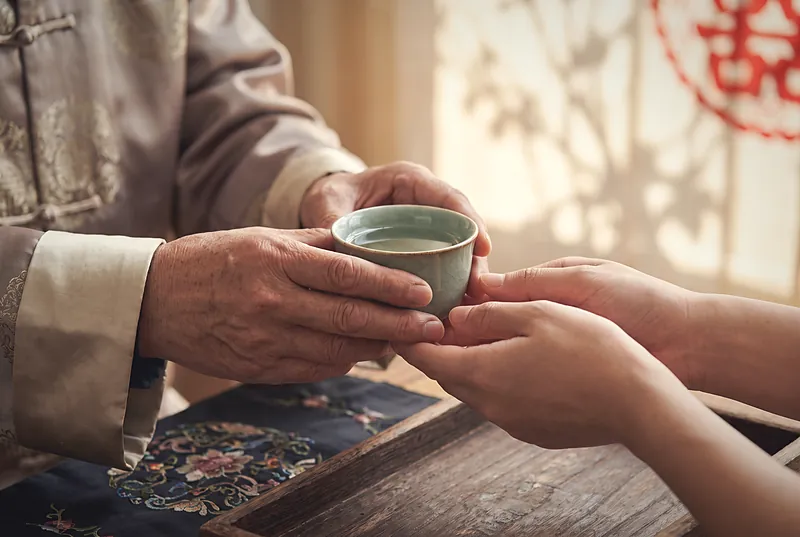
Use both hands. Offer the gift with both hands and say it is "just a small token". The person receiving usually accepts it with equal care and often waits to open it later, a quiet courtesy on both sides.
Blessings in a red box
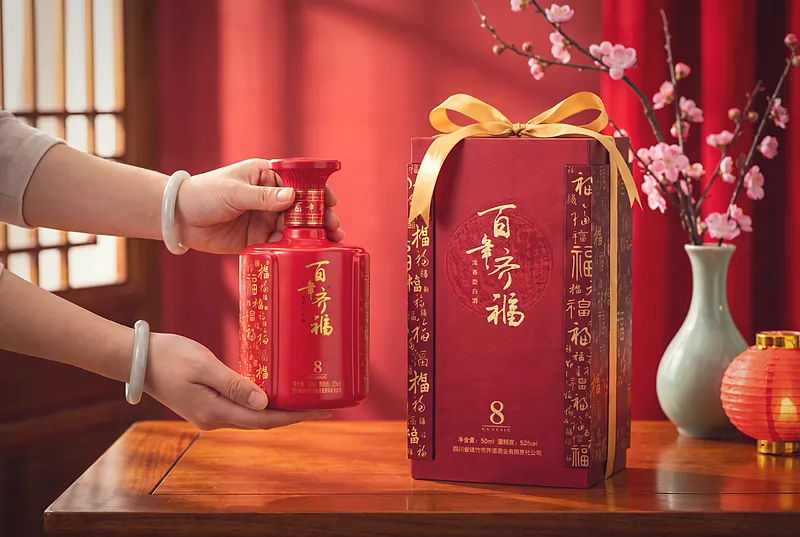
When it comes to New Year gifts, the spirit our family has distilled in Mianzhu for decades also comes in a red box. Bainian Qifu · 8 is Qifu's flagship: a strong-aroma baijiu at 52% vol in a 500 ml bottle, made from five grains (sorghum, wheat, rice, glutinous rice and corn). The red bottle sits in a red gift box finished with gold calligraphy, and it looks quietly at home on a festive table.
It enters smoothly, leaves a lingering sweetness, carries a full pit aroma and finishes with notes of nuts and caramel. It is a spirit for small cups, sipped slowly with family over the reunion dinner. The name Qifu means "blessings, all together", which makes it a fitting thing to give.
In the end, the weight of a gift lies in the thought behind it. We hope every bottle given is enjoyed slowly at someone else's table, and that it is enjoyed in moderation, which is the best way to honour the giver.