
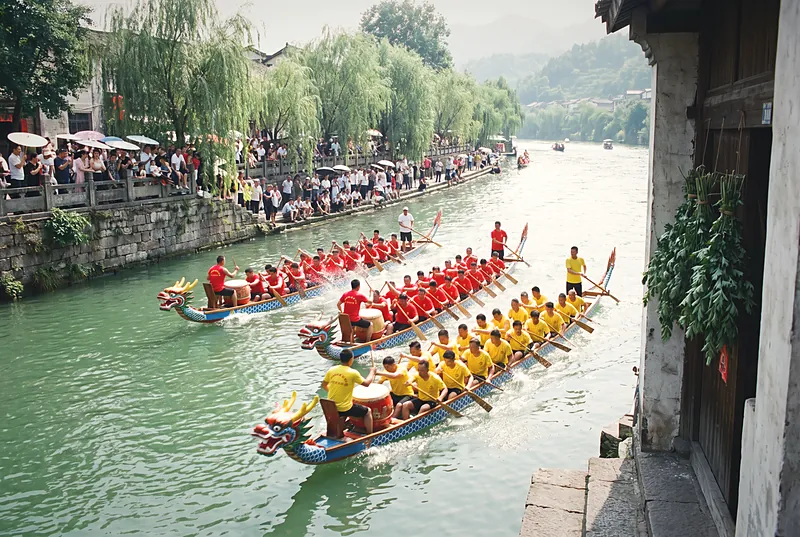
The fifth day of the fifth lunar month is Duanwu, the Dragon Boat Festival. On Sichuan's riverbanks it is always one of the liveliest days of the year: drums pound, dragon boats surge through the water, the crowds on the bank roar, and the scent of bamboo-leaf dumplings mixes with the smell of mugwort. It is the most vivid memory of early summer.
Dragon boats and Qu Yuan
There are many accounts of how the festival began. The most widely told links it to Qu Yuan, the poet-minister of the state of Chu in the Warring States period. Legend says that after he drowned himself in the Miluo River, local people rowed out to search for him and threw rice dumplings into the water so the fish would leave his body alone, and that dragon-boat racing and zongzi come from this. In the lower Yangtze region other traditions honour Wu Zixu or the filial daughter Cao E instead. In 2009 the Dragon Boat Festival was inscribed by UNESCO on the Representative List of the Intangible Cultural Heritage of Humanity 1.
Mugwort, calamus and seasonal wine
The ancients regarded the fifth month as an "ill month": hot, damp and full of insects. So many Duanwu customs are about warding off harm. The sixth-century Jingchu Suishiji records that on the fifth day of the fifth month:
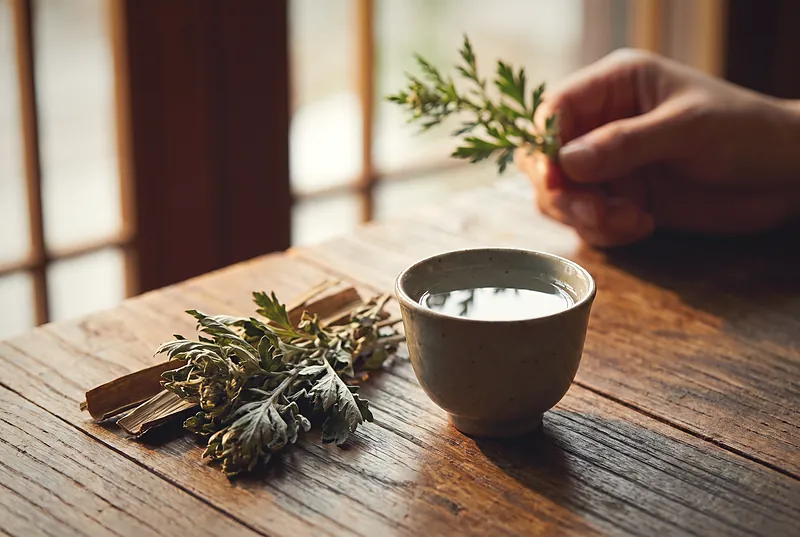
People gather mugwort, shape it into figures and hang them over their doors to ward off noxious airs.
— Zong Lin, Jingchu Suishiji
The same text says calamus root was carved or shredded and floated in wine 3. Hanging mugwort and calamus by the door is still a common sight in many Sichuan homes.
The seasonal wine of Duanwu was once calamus wine; later realgar wine became popular, drunk and dabbed on the skin in the hope of keeping insects and evil away. The scene in the Legend of the White Snake where Lady White unknowingly drinks realgar wine and reveals her true form made it famous. It should be said plainly, though, that realgar is an arsenic mineral and is now known to be toxic. Today the custom belongs to stories and memory, and is not one to follow 2.
A seasonal meal with Jin Qifu
Today Duanwu is more of an early-summer family gathering. After the boat races everyone heads home to zongzi, salted duck eggs and a few cold seasonal vegetables, with a good everyday bottle on the table. The point of a festival wine was never anything magical in the cup. It is a reason for the family to sit down and share a proper meal.
For a home-style meal like this, Jin Qifu is a natural choice. It is Qifu's everyday bottled range, made at the Qifu distillery at the foot of the Longmen Mountains in Mianzhu, where one family has kept to the old strong-aroma methods since 1978: pure grain, solid-state fermentation in yellow-mud pits under a red-grain cap for about two months, distillation in a zeng still, cutting by quality, and ageing in clay jars. Spirit for everyday drinking deserves the same care. And the name Qifu, "blessings, all together", suits a festival that brings the family home.
Early summer is hot, all the more reason to drink in moderation. Sip slowly from small cups alongside light seasonal dishes, watch the boats with your family and swap stories of how each household keeps the festival. The taste of the day lasts longer than the wine.